
Loading languages…
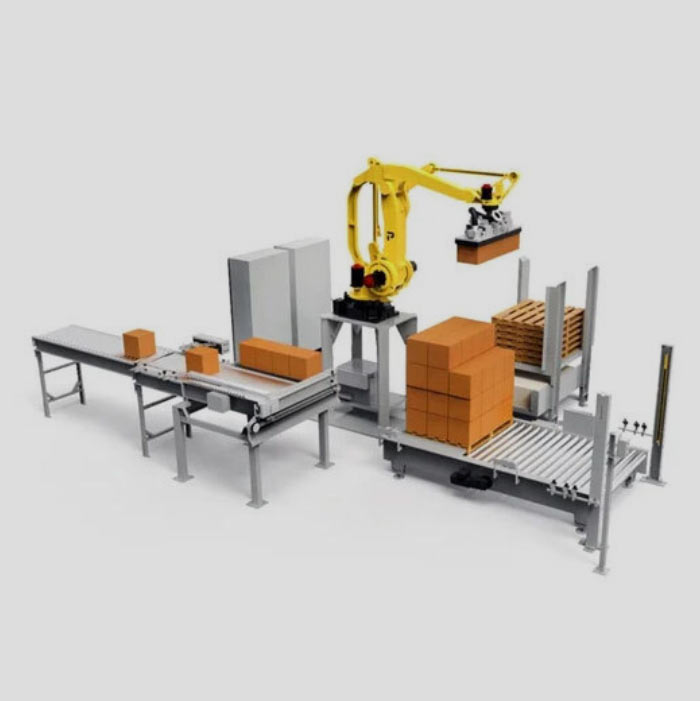


Palletizing is repetitive, heavy and rough on backs and shoulders. It is also one of the easiest jobs to automate. A robotic palletizer picks cases, bags or drums from a conveyor and stacks them on a pallet in a programmed pattern, shift after shift.
Avenue Automation designs robotic palletizing systems for manufacturers, warehouses and exporters in Dubai and across the UAE. We are ISO 9001:2015 certified and have worked in material handling and robot automation since 2020.
Each system is engineered for your product, pallet size and speed, with custom grippers made for what you handle.
A robotic palletizer is an industrial robot, often a 4-axis articulated arm, fitted with a gripper and controlled by a PLC with a touchscreen. Products arrive on a conveyor, a sensor detects them, and the robot lifts each one or each layer and places it in the right position on the pallet.
You choose stacking patterns on the HMI, and recipes let you switch between products and pallet formats in minutes. Safety guarding, light curtains or area scanners protect people working nearby.
The robot is only part of the system. The gripper, infeed and safety design decide the real output.
The right type depends on payload, speed and layout.
The table below gives typical ranges. Your specification depends on the product.
| Parameter | Details |
|---|---|
| Robot Axis | 4-Axis articulated robot (optional 6-Axis) for fully automatic, high-speed palletizing operations. |
| Payload Capacity | 5 kg to 800+ kg per cycle, depending on model and application requirement. |
| Operating Speed | 10–12 cycles per minute (up to 1,600–2,050 cycles per hour), subject to product and stacking pattern. |
| Working Reach | Up to 3.18 meters or more with R-axis rotation of 330°–440° for flexible movement. |
| End-of-Arm Tooling (EOAT) | Custom-designed vacuum, magnetic, or pneumatic grippers for bags, cartons, bottles, and drums. |
| Construction Material | Heavy-duty MS or SS304 structure designed for continuous industrial operation. |
| Power Supply | 3-Phase 415V / 220V, 50/60 Hz with required pneumatic supply (approx. 6 bar). |
| Control System | Advanced PLC with touchscreen HMI supporting recipe-based pallet patterns and quick changeover. |
Customers choose robotic palletizers for safety, consistency and output.
Palletizing is needed in nearly every plant that ships cases or bags.
These factors help to size the system.
We deliver complete working cells, not just robots.
A robot that stacks cases, bags or drums onto pallets automatically in programmed patterns.
Typically 10 to 12 cycles per minute, about 1,600 to 2,050 cycles per hour, depending on product and pattern.
From 5 kg to over 800 kg per cycle, depending on the model.
A cobot palletizer is built to work beside people at lower speeds, often with less guarding. Standard robotic palletizers are faster and usually enclosed.
Yes. Different pallet patterns can be stored as recipes, and grippers can be designed for several product types.
Machines that work with a palletizer: end of line packaging machines | bag stacker conveyors | automatic bag filling machines | secondary packaging machines.
Ready to take heavy lifting off your team? Contact Avenue Automation for a robotic palletizer designed for your plant in Dubai.