


Loading languages…

Top 10 Flexible Roller Conveyor manufacturers in Dubai 2026

Not every warehouse can bolt a conveyor to the floor. A flexible roller conveyor stretches out when you need it, folds away when you do not, and rolls on casters to wherever the work is.

Avenue Automation manufactures gravity and powered flexible roller conveyors for warehouses, packing lines and loading docks. We supply customers across Dubai and the UAE and have been building material handling equipment since 2020, with ISO 9001:2015 certified processes.

If your layout changes with the season, the customer or the shift, this is usually the most economical way to move cartons.

What Is a Flexible Roller Conveyor?

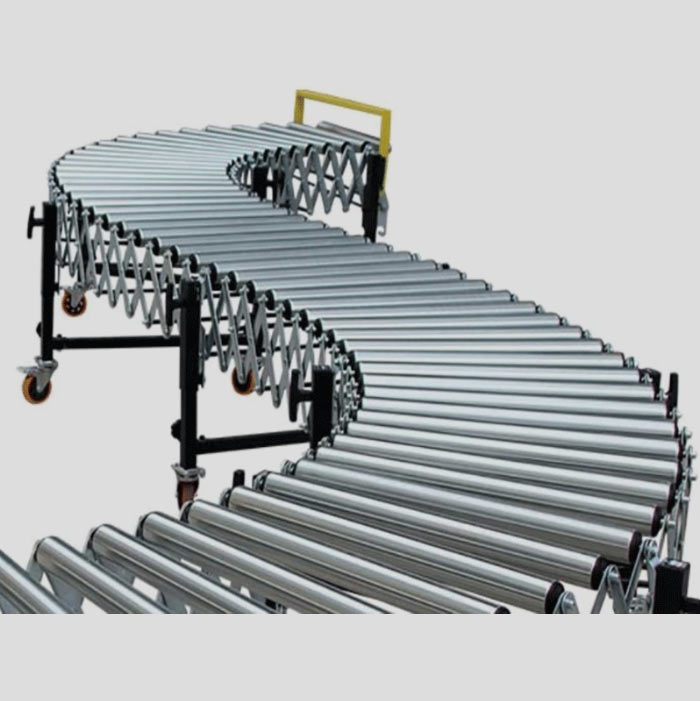
A flexible roller conveyor, also called an expandable or extendable roller conveyor, is a set of rollers mounted on a scissor-style frame that expands and collapses like an accordion. Standard units expand to about three times their collapsed length.

Gravity models rely on a slight decline, while powered models use a motor to move cartons at up to 25 m per minute. Side plates, swivel casters and telescopic legs allow it to be curved, straightened and set to different heights.

How We Build Flexible Roller Conveyors

The scissor frame has to extend smoothly thousands of times, so tolerances and welding matter.

  • Design: We confirm the expansion length, width and load before cutting any steel.
  • Frame and side plates: Heavy-duty welded Z-section side plates give rigidity while allowing expansion.
  • Roller selection: Galvanised steel, PVC or stainless rollers from 38 to 50 mm in diameter are matched to the product.
  • Legs and casters: Telescopic legs adjust height from 550 to 950 mm, and locking swivel casters fix the position.
  • Powered options: Where required, a drive unit is added to give variable speed up to 25 m/min.
  • Testing: Every unit is fully extended and collapsed under load before dispatch.

Types of Flexible Roller Conveyors

We offer five main variants.

  • Gravity flexible roller conveyor: No power, lowest cost, ideal for light cartons.
  • Powered flexible roller conveyor: Motorised rollers for steady, controlled movement.
  • Skate wheel flexible conveyor: Lightweight, for lighter cartons and bags with smooth bases.
  • Heavy-duty flexible roller conveyor: Reinforced frames and bigger rollers for heavier loads.
  • Flexible belt conveyor: A belt in place of rollers for small or irregular items.

Flexible Roller Conveyor Specifications

Standard widths and heights are listed below. We can adjust them to your needs.

Specification Details
Expansion Ratio1:3 (collapsed to fully extended)
Conveyor Widths412 mm, 462 mm, 512 mm, 612 mm, 762 mm
Height Adjustment550 mm – 950 mm (telescopic legs)
Load CapacityUp to 150 kg per linear meter
Roller Diameter38 mm – 50 mm (1.5" – 1.97"), galvanized steel, PVC, or stainless steel
Speed (Powered)Up to 25 m/min, variable
Frame StructureHeavy-duty welded “Z” section side plates with locking swivel casters
Key FeaturesSelf-tracking, package stoppers, bidirectional operation, modular design

Advantages of Flexible Roller Conveyors

Their greatest strength is that they adapt to your day, not the reverse.

  • Space-saving: Collapse when not in use and free the aisle.
  • Quick setup: Move into place and lock casters in minutes, with no foundations.
  • Adjustable height and length: Match different truck beds and work stations.
  • Low running cost: Gravity versions need no electricity at all.
  • Bidirectional use: Powered models run both ways for loading or unloading.

Where Flexible Roller Conveyors Are Used

These conveyors are a favourite in busy Dubai warehouses where space is expensive.

  • Truck and container loading: Reach into the trailer to load or unload cartons.
  • Packing and sorting stations: Feed cartons to packers and checkers.
  • Dock feeding: Move goods from a pallet to the next process.
  • Assembly line buffering: Hold product between stages.
  • Temporary or seasonal lines: Set up extra capacity at peak times.

Choosing the Right Flexible Roller Conveyor

Match the specification to your product and routine.

  • Carton weight and base: Hard, flat bases suit rollers, while soft bags may need a belt.
  • Length expanded and collapsed: Check both the reach and the parking space.
  • Gravity or powered: Use gravity if you can have a decline, and powered if you cannot.
  • Surface: Galvanised for general use, stainless steel for washdown or food areas.

Why Choose Avenue Automation for Flexible Conveyors

We manufacture our flexible conveyors in-house, allowing us to customize them to your specific requirements.

  • Custom widths and heights: From 412 to 762 mm wide and 550 to 950 mm high as standard.
  • Sturdy construction: Heavy side plates and good rollers last longer than light-duty imports.
  • Easy to integrate: They link to telescopic, truck loading and fixed conveyors.
  • Fast response: Direct communication with our engineers.

Flexible Roller Conveyor FAQs

How far does a flexible roller conveyor extend?

Most expand to about three times their collapsed length. A unit that collapses to 1.5 metres, for example, extends to roughly 4.5 metres.

How much weight can it carry?

Our standard range carries up to 150 kg per linear metre, with heavier duty available.

Is it gravity or powered?

Both are available. Gravity units need a slight decline, and powered units run up to 25 m/min.

Can it be used for truck loading?

Yes. Many customers use powered flexible conveyors to reach into trucks, particularly when a full telescopic belt conveyor is more than they need.

Can it go around corners?

Yes. The scissor frame flexes sideways, so the conveyor can form curves.

Related Solutions from Avenue Automation

Other conveyor options to look at: telescopic conveyors | truck loading conveyors | material handling conveyors | conveyor systems.

Need a conveyor that moves with your workflow? Contact Avenue Automation to get a flexible roller conveyor made to your size for your site in Dubai.

Location